To understand this easily, Imagine stretching a spring and storing energy. When released, that stored energy becomes motion and heat. Similarly, the energy driving inflation got converted into particles, light, radiation and matter. The universe suddenly becam
SP
Siddhartha PradeepNovember 29, 2020 · 32 min read · Updated August 4, 2026
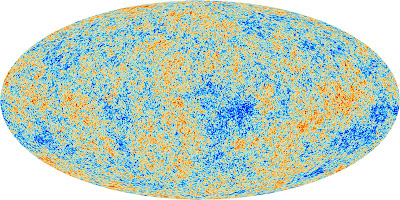
When we look into the night sky, we usually see stars, planets and galaxies. But hidden behind all these visible objects is a much older light—radiation that has been travelling through space for almost the entire history of the universe.This radiation is called the **Cosmic Microwave Background**, or **CMB**. It is often described as the universe’s “baby picture,” but that phrase understates its importance. The CMB is not merely an ancient photograph. Encoded within its tiny variations are clues about the universe’s geometry, composition, expansion history and the primordial fluctuations from which galaxies eventually formed.To understand the CMB, we must first return to the earliest moments of cosmic history.1. What the Big Bang actually meansAccording to modern cosmology, the observable universe has been expanding from an extremely hot, dense early state for approximately **13.8 billion years**.The Big Bang should not be imagined as an explosion occurring at one point inside pre-existing empty space. It was not like a bomb exploding in a dark room. Rather, **space itself expanded**, everywhere at once.A helpful analogy is the surface of an inflating balloon. As the balloon expands, every marked point moves away from every other point. No point on the surface needs to be the centre of the expansion. The analogy is imperfect because the balloon expands into a surrounding three-dimensional space, whereas the universe does not necessarily need an external space into which it expands. Nevertheless, it helps illustrate why the Big Bang did not occur at a single location in today’s universe.If we mathematically run the equations of general relativity backwards, the density and temperature appear to increase without limit, producing what is called a **singularity**. However, most physicists do not interpret this as proof that the universe literally began as an infinitely dense point. Instead, the singularity probably signals that general relativity has been pushed beyond the domain in which it can be trusted.In simpler terms, imagine watching a movie of the expanding universe backwards. Galaxies get closer. Distances shrink. Density increases. Temperature increases. Eventually, Einstein's equations predict: density is infinie, temperature is infinite and size is zero. This mathematical point is called a singularity. Does that mean the universe really became infinitely small? Probably not. This is one of the most important misconceptions. The singularity is not necessarily something that physically existed. It is more like your calculator displaying ERROR. Suppose you calculate 1/0, your calculator says infinity. Your calculator doesn't conclude that infinity physically exists there. It tells you that "My equations don't work anymore."Physicists think the Big Bang singularity is similar. General Relativity works incredibly well for stars, planets and galaxies. But if you push it to unimaginably high densities, it breaks down.The singularity is therefore believed to be a sign that our theory has reached its limit, not necessarily that nature truly contained an infinite density.General Relativity describes gravity beautifully. Quantum mechanics describes atoms and tiny particles beautifully. Near the Big Bang, both effects become equally important. Therefore, at sufficiently early times, quantum effects should become important, requiring a theory of **quantum gravity**. Because no experimentally confirmed theory yet unifies gravity with quantum mechanics, physics cannot presently provide a reliable account of the earliest conceivable instant—or say with confidence whether the universe had an absolute beginning, emerged from an earlier phase or arose through some deeper process.The hot Big Bang model therefore describes the evolution of the universe from a very early hot and dense state. It does not yet provide a complete explanation of why the universe exists or what, if anything, preceded that state.2. Inflation: an extraordinary early expansionMany cosmologists believe that, before the conventional hot Big Bang phase, the universe underwent an extremely brief period of accelerated expansion called **cosmic inflation**.The modern inflationary idea was developed in the late 1970s and early 1980s through the work of physicists including Alexei Starobinsky, Alan Guth, Andrei Linde, Andreas Albrecht and Paul Steinhardt.Inflation may have occurred around (10^{-36}) to (10^{-32}) seconds after the earliest physically meaningful moment, although the exact timing depends on the particular model. During this interval, the scale of the universe may have increased by a factor of at least approximately (10^{26}), and perhaps considerably more.This does not mean that objects travelled through space at many times the speed of light. General relativity does not forbid **space itself** from expanding so rapidly that the distance between sufficiently separated locations increases faster than light could travel between them.Imagine drawing two dots on a rubber sheet and stretching the sheet. The dots are not propelling themselves across the rubber; the material between them is expanding. Inflation applies a much more extreme version of this idea to space itself.Why was inflation proposed?Inflation helps explain several otherwise puzzling observations.1) First, the universe appears remarkably uniform on very large scales. Regions of the sky that are now separated by enormous distances have nearly identical CMB temperatures. Without inflation, some of these regions would never have had enough time to exchange light or heat and reach a common temperature. This is known as the **horizon problem**.For example: Imagine two children born on opposite sides of Earth who have never communicated. Yet both somehow wrote the exact same essay. You'd think, "How could they coordinate?"Similarly, parts of the universe that are billions of light-years apart should never have been able to exchange information. So why are they almost identical? This is called the Horizon Problem. And inflation answers this by saying that before inflation, those regions were actually very close together.2) Second, the observable universe appears spatially very close to flat. Inflation naturally drives any initially curved region towards apparent flatness, just as a small patch on the surface of an enormous sphere looks nearly flat.3) Third, inflation helps explain why hypothetical heavy relics, such as magnetic monopoles predicted by some particle-physics theories, are not commonly observed. Their density would have been diluted almost to nothing by the tremendous expansion.Most importantly, inflation provides a possible origin for the tiny irregularities that later became galaxies and galaxy clusters.The inflaton fieldWhat caused inflation? Scientists don't know. But one popular idea is a hypothetical field called the inflaton. While the inflaton evolves slowly through a high-energy state, its energy behaves somewhat like a temporary cosmological constant, producing accelerated expansion.In simpler terms, think of it like a temporary source of energy filling space. As long as this field existed, space expanded incredibly fast. Eventually, the field lost its energy, and inflation ended.The inflaton remains hypothetical. No inflaton particle has been detected, and physicists do not yet know whether inflation was driven by one field, several fields, a modification of gravity, or some other mechanism.Inflation is therefore better regarded as a powerful framework containing many possible models rather than a single fully established theory.When inflation ended, the energy associated with the inflationary state was converted into particles and radiation through processes commonly described as **reheating**. This produced the extremely hot, particle-filled conditions from which the familiar hot Big Bang evolution proceeded.
To understand this easily, Imagine stretching a spring and storing energy. When released, that stored energy becomes motion and heat. Similarly, the energy driving inflation got converted into particles, light, radiation and matter. The universe suddenly became extremely hot. This hot state is exactly where the ordinary Big Bang model begins.
Thus, in modern terminology, inflation did not necessarily occur “after the Big Bang.” More precisely, inflation may have prepared the initial conditions for the **hot Big Bang phase**.So, does that mean scientists know everything?
No.
Inflation is one of the most successful ideas in cosmology because it explains many observations, but it is not proven. Scientists still don't know:
- what the inflaton really is,
- whether there was one field or many,
- whether inflation happened exactly as proposed,
- or whether another theory could explain the same observations.
So inflation is better thought of as a family of models that fit the evidence well, rather than a completely established theory.
3. Expansion after inflation—and the role of dark energyAfter inflation ended, the universe continued expanding. However, it is important not to attribute all subsequent expansion directly to dark energy.Cosmic expansion can continue because it is part of the evolving geometry of spacetime. Different forms of matter and energy affect whether that expansion speeds up or slows down.For much of the early universe, radiation and matter exerted enough gravitational influence to **decelerate** the expansion. Dark energy was present—assuming it is a cosmological constant—but its density was dynamically insignificant compared with the enormous densities of radiation and matter.Only several billion years ago did dark energy become dominant enough to cause the cosmic expansion to begin accelerating again.The phrase **Hubble expansion** simply refers to the large-scale recession of distant galaxies as space expands. It is not another name for dark energy. Dark energy is the unknown component that appears to explain why the present expansion is accelerating.The early inflationary expansion and today’s dark-energy-driven acceleration resemble one another mathematically, but it is not known whether they arise from the same physical mechanism.4. The young universe was a glowing plasmaImmediately after reheating, the universe was extraordinarily hot and dense. As it expanded, its temperature fell and it passed through a succession of stages.At very high temperatures, matter could not remain assembled into familiar structures. Atoms, atomic nuclei and even many composite particles could not survive. As cooling continued, quarks became confined inside protons and neutrons. During the first few minutes, some protons and neutrons combined to form light atomic nuclei, principally hydrogen and helium nuclei, with small amounts of deuterium and lithium.This period is known as **Big Bang nucleosynthesis**.However, the universe remained far too hot for complete atoms to form. The thermal radiation constantly struck any newly bound electrons with enough energy to separate them from nuclei.The universe therefore consisted largely of a hot **plasma**: positively charged nuclei, free electrons, photons, neutrinos and other particles.Why was the universe opaque?Photons repeatedly interacted with free electrons, primarily through **Thomson scattering**.Imagine trying to see through a very dense fog. Water droplets continuously scatter visible light, preventing it from travelling far in a straight line. In the early universe, free electrons played a role similar to the droplets. A photon could travel only a short distance before being scattered in another direction.Its **mean free path**—the average distance travelled between interactions—was therefore very small compared with cosmic distances.Radiation and ordinary matter were tightly coupled into a photon–baryon fluid. Photons constantly pushed against charged matter, while gravity pulled overdense regions inward. These competing forces produced pressure waves through the plasma.They were, in a physical sense, sound waves moving through the early universe.5. The cosmic orchestra: acoustic oscillationsSuppose a small region of the primordial universe contained slightly more matter than its surroundings. Its stronger gravity would draw additional material inward.But the inward-falling matter was coupled to an enormous number of energetic photons. Radiation pressure resisted compression and pushed the material outward. Gravity would then begin pulling it inward again.The result was an oscillation: gravity compressed the fluid, radiation pressure expanded it, and the pattern repeated.A useful analogy is a spring. Gravity acts like the force compressing the spring, while photon pressure acts like the restoring force pushing it back.These waves are called **baryon acoustic oscillations**. In this context, *baryons* are ordinary-matter particles such as protons and neutrons.Different regions had different amounts of time to oscillate before photons decoupled from matter. Some waves had reached maximum compression, some maximum rarefaction, and others an intermediate phase. When the universe became transparent, the oscillations were effectively frozen into the distribution of matter and radiation.Their imprint appears today as a series of peaks in the CMB’s **angular power spectrum**. A related imprint remains in the large-scale distribution of galaxies and is also called the baryon acoustic oscillation feature.In this sense, the universe contains a fossil record of its earliest sound waves.6. Expansion caused the universe to coolAs space expanded, the wavelengths of freely moving radiation were stretched. Longer-wavelength photons have lower energy, so the radiation temperature fell.This cooling is related to adiabatic expansion, but it is best understood through the behaviour of radiation in an expanding spacetime: as the scale factor of the universe increases, photon wavelengths grow in proportion, while the radiation temperature decreases.A loose analogy is gas cooling as it expands, although the cosmological situation is more fundamental because spacetime itself is expanding.After approximately **380,000 years**, the average cosmic temperature had fallen to roughly **3,000 kelvin**. Conditions had finally become cool enough for electrons to remain bound to protons and helium nuclei.This period is traditionally called **recombination**, although “combination” would be more literal because these electrons and nuclei had not necessarily been joined previously.Hydrogen nuclei captured electrons to form electrically neutral hydrogen atoms. Helium underwent related transitions somewhat earlier and in multiple stages.7. Recombination and photon decouplingOnce most free electrons had become bound inside neutral atoms, the number of particles capable of efficiently scattering photons dropped dramatically.Bound electrons can still interact with light, but they do so very differently from free electrons. An atom absorbs photons strongly only at particular energies corresponding to transitions between its allowed quantum states. Photons with other energies can travel much more freely.The cosmic fog therefore cleared.In other words, A free electron was like a person standing in the middle of a hallway. Every passing photon bumps into it. Lots of scattering happens. Now imagine the electron is locked inside a house. It doesn't interact with every passing photon. It only responds if the photon has exactly the right energy to excite the atom. So most photons simply continue on their way.So, when photons stopped being continually scattered and began travelling almost uninterrupted across the universe. This process is known as **photon decoupling**.Recombination and photon decoupling occurred during the same broad era but are not exactly the same event. Recombination describes the formation of neutral atoms; decoupling describes the moment when photons ceased interacting frequently enough to remain in thermal equilibrium with matter.The transition was also not instantaneous. The photons we observe today last scattered across a finite interval of time and distance known as the **surface of last scattering**.So, let's simplify the surface of last scattering further: This is one of the coolest ideas in cosmology.Imagine standing in a forest. You can only see until the trees become too dense. That boundary is your "visibility limit." The universe has something similar. Wherever we look, eventually we reach the point where the universe was still opaque. That is the surface of last scattering.It is called the "last scattering" surface because the photons we see today had their final interaction with matter there before traveling freely to us.This “surface” is not a physical wall surrounding Earth. Because light takes time to travel, looking farther away means looking further back in time. In every direction, we eventually look far enough back to reach the era when the universe first became transparent. That spherical observational boundary is the surface of last scattering. Every observer anywhere in the universe would see their own surface of last scattering centered on themselves.NASA describes this transition as occurring around 380,000 years after the Big Bang, when atomic nuclei captured electrons and the universe became transparent to light.8. From a 3,000-kelvin glow to microwavesAt decoupling, the released radiation had a temperature of approximately 3,000 K. Such radiation would have been concentrated largely in the visible and near-infrared portions of the electromagnetic spectrum, giving the universe an orange-red glow.But space continued expanding for billions of years.As the universe expanded, the wavelengths of these photons stretched by a factor of roughly 1,100. Radiation that once had visible or infrared wavelengths was shifted into the microwave region.Today, the radiation has a temperature of approximately **2.725 K**, only a few degrees above absolute zero. NASA’s COBE measurements found its spectrum to be extremely close to that of a perfect blackbody, with a temperature near 2.725 K.This relic radiation is the **Cosmic Microwave Background**.The CMB is not light emitted by a single object or location. It comes from every direction because every line of sight eventually reaches a region of the primordial plasma from which photons last scattered.The radiation’s spectral radiance per unit frequency peaks at approximately **160 GHz**, corresponding to a wavelength of about 1.9 millimetres. The precise location of a blackbody’s “peak” depends on whether its intensity is plotted per unit wavelength, per unit frequency or in another convention, so different peak values may appear in different contexts without contradiction.9. How Penzias and Wilson discovered the CMBThe CMB was predicted before it was detectedIn the 1940s, George Gamow, Ralph Alpher and Robert Herman developed early hot Big Bang models and argued that the universe should contain residual thermal radiation from its hotter past. Their prediction was not immediately pursued and was largely overlooked for several years.In the 1960s, a group at Princeton University led by Robert Dicke, with researchers including Jim Peebles, David Wilkinson and Peter Roll, independently began investigating the possibility of such background radiation.At approximately the same time, Arno Penzias and Robert Wilson were working with a sensitive horn antenna at Bell Telephone Laboratories in New Jersey.They encountered a persistent microwave signal that appeared regardless of the direction in which they pointed the antenna. The noise did not disappear when they accounted for the atmosphere, nearby cities, electronic equipment or known astronomical sources. Even after cleaning pigeon droppings—memorably described as a dielectric material—from the antenna, the signal remained.Through communication involving astronomer Bernard Burke, Penzias learned of the Princeton group’s work. The two teams realised that Bell Labs had accidentally detected the radiation that the Princeton researchers were preparing to search for.In 1965, they published companion papers: Penzias and Wilson reported the unexplained microwave background, while the Princeton group explained its cosmological significance.Penzias and Wilson later received the 1978 Nobel Prize in Physics for the discovery.10. Why the CMB is almost a perfect blackbodyA **blackbody** is an idealised object that absorbs and emits radiation with a spectrum determined solely by its temperature.
Think of a blackbody as the perfect heater. If you heat an object, the color and type of light it emits depends only on its temperature, not on what it is made of. For example:
- a warm iron rod glows dull red
- a hotter one becomes orange,
- an even hotter one becomes white.
The exact pattern of light changes in a very predictable way. That predictable pattern is called a blackbody spectrum.
Why was the early universe a black body?The early universe was dense enough that photons interacted repeatedly with charged particles. These interactions brought radiation and matter extremely close to thermal equilibrium. The radiation therefore developed a blackbody spectrum.In other words, remember the universe before photon decoupling. It was filled with photons, electrons, andprotons. Everything kept colliding continuously. These collisions happened billions upon billions of times.Eventually, everything settled into the same temperature. This is called thermal equilibrium.Why does thermal equilibrium matter?Whenever radiation is in perfect thermal equilibrium, physics predicts something remarkable. The light musthave a blackbody spectrum. Not "probably." Not "approximately." It naturally settles into that exact pattern. So if the early universe really was hot, dense, and in thermal equilibrium, we should observe a blackbody spectrum today.After decoupling, cosmic expansion stretched every photon wavelength by approximately the same factor. Remarkably, stretching a blackbody spectrum in this way preserves its blackbody form while lowering its temperature. This is one of the beautiful results in cosmology.It is similar to taking a perfectly shaped musical chord and shifting every note downward by the same proportion. The pitch changes, but the relationships among the notes remain intact.
Similarly, every photon wavelength stretched by the same cosmic expansion factor. So, the temperature decreased but the overall blackbody shape remained perfect. The spectrum simply "slid" to lower energies without changing its characteristic shape.
The COBE satellite’s FIRAS instrument found that the CMB spectrum deviates from a perfect blackbody by no more than a tiny fraction across the measured range. NASA reports a temperature of approximately 2.725 K and deviations from blackbody form at only around the hundredths-of-a-percent level.This is one of the most precise agreements between theoretical prediction and observation in all of science. It provides exceptionally strong evidence that the universe once existed in a hot, dense, thermal state.11. COBE, WMAP and Planck: increasing the resolutionThree satellite missions transformed the study of the CMB.COBE: NASA’s **Cosmic Background Explorer**, launched in 1989, established two foundational results. Its FIRAS instrument showed that the CMB has an almost perfect blackbody spectrum.Its Differential Microwave Radiometer detected intrinsic temperature variations across the sky at approximately the level of one part in 100,000. These were the first clear observations of the primordial irregularities from which cosmic structure developed.WMAP:NASA’s **Wilkinson Microwave Anisotropy Probe**, launched in 2001, mapped these fluctuations at much finer resolution.WMAP helped establish what became known as the **concordance model** of cosmology: a universe dominated by dark energy and cold dark matter, containing a smaller fraction of ordinary matter and beginning with nearly scale-invariant primordial fluctuations.PlanckThe European Space Agency’s **Planck** satellite, launched in 2009, mapped temperature and polarisation variations with still greater sensitivity and angular resolution.Planck’s measurements placed extremely tight constraints on cosmological parameters and showed that the six-parameter base ΛCDM model provides an excellent description of a vast range of CMB observations. ESA’s final Planck cosmology release includes temperature, polarisation, lensing and cosmological-parameter products derived from the mission.The mission names are written **WMAP** and **Planck**, rather than WMP and Plank.12. The tiny anisotropies that built the cosmosThis is one of the most beautiful ideas in cosmology. It answers the question: "If the early universe was almost perfectly smooth, where did galaxies, stars, and planets come from?" The answer is: The universe wasn't perfectly smooth. It had tiny imperfections. Those tiny imperfections grew into everything we see today. Let's understand this step by step.First, remember the CMB. The Cosmic Microwave Background (CMB) is like a photograph of the universe when it was about 380,000 years old. If you looked at that picture with your eyes, it would appear almost perfectly uniform. Everything looks nearly the same. But when scientists measure it extremely carefully... they discover tiny differences.How tiny are these differences? The average temperature of the CMB is 2.725 Kelvin. Different regions differ by only about 0.00001%. Example: One room is 20.00000°C and another room is 20.00020°C. You would never notice the difference. Yet incredibly sensitive instruments can. The CMB variations are this kind of tiny difference.Why are these tiny differences important?Because temperature tells us about density. A slightly hotter or colder region usually means slightly more matter, or slightly less matter, or different motion, or different gravity.In other words, the universe wasn't perfectly uniform. Some places contained just a tiny bit more matter than others.Imagine two regions. One has 100 particles and other had 101 particles. Only one extra particle. That tiny difference means the second region has slightly stronger gravity. So it pulls in nearby matter. Now it has 110 particles Its gravity becomes stronger. Now it pulls even more matter. Eventually, the tiny difference keeps growing. Gravity acts like a snowball rolling downhill—it starts small but gathers more and more material as it goes.13. Quantum fluctuations enlarged to cosmic scalesOne of inflation’s most striking ideas is that the seeds of galaxies may have originated as microscopic quantum fluctuations.First, what is a quantum fluctuation?In everyday life, we imagine that if something is perfectly calm, nothing happens.For example, imagine a perfectly still lake. No ripples. No movement. Classical physics says this is possible.Quantum mechanics says something very different. Even in the lowest possible energy state, things are never perfectly still. Instead, there are tiny unavoidable fluctuations.Imagine the lake constantly having microscopic ripples. These ripples are not caused by wind. They arise because of the quantum nature of reality. So, quantum fields cannot remain perfectly uniform. Even in their lowest-energy states, they undergo unavoidable fluctuations.What is fluctuating?Modern physics says that the universe is filled with quantum fields. For example, the electron field, the photon field, and, in many inflation models, the inflaton field. Particles are excitations of these fields. Even when there are no particles, the fields themselves cannot remain perfectly constant. They fluctuate slightly. These are quantum fluctuations.Normally these fluctuations are tiny. Under ordinary conditions, quantum fluctuations occur only at incredibly small scales. Think about a tiny ripple on a pond that is only one atom wide. It has no effect on cities or mountains. Likewise, ordinary quantum fluctuations normally remain microscopic.
Digreesion to understand this better
1. The Key Player: The Cosmic HorizonIn any expanding universe, there is a boundary called the Hubble Horizon (or cosmic event horizon). - Inside the horizon: Space is small enough that forces and light can travel from one side of a wave to another. Physics acts normally, and waves can oscillate back and forth (crest becomes trough, trough becomes crest). - Outside the horizon: Two points are separated by so much expanding space that light cannot bridge the gap. They are causally disconnected—they can no longer communicate or interact.2. Step-by-Step: How the Fluctuation FreezesStep 1: Normal Quantum VibrationBefore inflation stretches a particular mode, a quantum fluctuation in the inflaton field acts like a normal microscopic wave. It constantly oscillates up and down because the forces within the field pull it back toward equilibrium.Step 2: Exponential Stretching (Horizon Exit)During inflation, space expands exponentially. A microscopic quantum wave with a tiny wavelength $\lambda$ gets stretched violently. In a tiny fraction of a second, the physical wavelength of this ripple grows larger than the Hubble horizon. This event is called Horizon Exit.Step 3: The FreezeFor a wave to keep oscillating, its crest needs to "feel" its trough so that pressure and field forces can pull it back down. Once the wavelength is stretched outside the horizon, the left side of the wave can no longer communicate with the right side—even at the speed of light. Without this causal communication: The restorative forces that cause the wave to vibrate cannot operate across the crest and trough. The wave stops oscillating. Its height (amplitude) gets locked into place.Analogy: Imagine plucking a rubber band so it vibrates rapidly. Now imagine stretching the rubber band outward so fast that the two ends move apart faster than the vibration wave can travel. The vibration stops—the rubber band gets stretched taut into whatever shape it had at that moment.3. Turning Quantum Uncertainty into Classical RealityWhen the fluctuation freezes outside the horizon, two critical transformations occur:Amplitude becomes Static Density: What was once an oscillating quantum field mode becomes a permanent, motionless variation in energy density. Some patches of space are frozen with slightly higher energy, and others with slightly lower energy. Quantum to Classical Transition: Because the wave is stretched to macroscopically huge dimensions, quantum superposition and interference effects become completely unobservable (a process called decoherence). The quantum fluctuation effectively becomes a standard, classical landscape of high-density and low-density regions.What Happens Next? (Re-entry)When inflation ends, the exponential stretching stops, and the normal expansion of the universe resumes. As the universe continues expanding at a slower rate, the horizon grows back faster than the frozen waves do. Eventually, these frozen density variations re-enter the horizon. By the time they re-enter, they are no longer quantum ripples—they are massive, static regions of slightly extra gravity that pull gas together to build the first stars, galaxies, and galaxy clusters.Another way to understand the re-entry: Imagine space is a massive, flexible rubber sheet. During Inflation, the rubber sheet stretches violently—so fast that a tiny quantum ripple drawn on the sheet gets pulled apart faster than anything can move across it. The ripple freezes into place because its left side can't talk to its right side.Once inflation stops, space keeps expanding, but at a much slower, normal pace. Now, imagine two things happening at the same time:- The Stretched Ripple: Since the rubber sheet is now stretching slowly, the size of our frozen ripple grows at a modest speed (think of it like walking speed).- The Light Signal (The Runner): A beam of light trying to cross the ripple is running at full speed. Because space is no longer expanding super-fast, the runner easily outpaces the slow stretching of the sheet.Even though the light itself gets slightly stretched out along the way, the runner steadily gains ground on the ripple.Eventually, the light reaches the other side. The moment light can cross from the crest of the wave to its trough, the two sides can "see" each other again.Forces like gravity and pressure instantly wake up, communication is restored, and the frozen ripple un-freezes—starting to collapse under gravity to form the seeds of stars, galaxies, and planets. So, continuing our discussions, during inflation, space expanded so rapidly that tiny fluctuations in quantum fields were stretched to astronomical and eventually cosmological scales. Once stretched beyond the effective horizon, they could no longer be smoothed out by ordinary causal processes.So after inflation, these fluctuations re-entered the horizon as variations in density and spacetime curvature. Gravity then amplified them. In this picture, galaxies—including the Milky Way—and, therefore, stars, planets, and living organisms ultimately owe their existence to quantum variations in the infant universe.This is among the deepest connections in modern physics: quantum mechanics, normally associated with atoms and subatomic particles, may have created patterns spanning billions of light-years.The CMB observations strongly support several broad inflationary predictions: - primordial fluctuations were approximately Gaussian; - their spectrum was nearly, but not exactly, scale-invariant; - the universe is spatially close to flat; - fluctuations were predominantly adiabatic, meaning the relative compositions of different regions initially varied together in a particular way.However, these successes do not uniquely identify the inflationary mechanism. Many different inflationary models produce similar predictions.14. Reading the CMB power spectrumA full-sky CMB map looks like a mottled pattern of warm and cool regions. To extract cosmological information, scientists decompose the pattern according to its angular scales.Large features correspond to low multipole values, usually denoted by (\ell), while small features correspond to high values of (\ell).The resulting graph is called the **angular power spectrum**.One may think of it as separating a musical recording into bass, middle and treble frequencies. Instead of asking only how loud the complete recording is, we ask how much variation exists at each scale.The peaks in this spectrum are known as **acoustic peaks**.The first acoustic peakThe position of the first major peak is closely related to the apparent angular size of the sound horizon at recombination—the greatest distance through which an acoustic wave could have travelled by that time.Its measured position tells us that the universe is spatially very close to flat.The relative peak heightsThe relative heights of the peaks reveal the contents of the universe.Ordinary baryonic matter enhances compressions differently from rarefactions, changing the balance between alternating peaks. Dark matter affects the depth and evolution of gravitational wells. Radiation, neutrinos and the expansion rate leave additional signatures.By fitting the entire spectrum, cosmologists can infer quantities such as:* the density of ordinary matter;* the density of dark matter;* the geometry and age of the universe;* the initial spectrum of primordial fluctuations;* the optical depth produced when the first stars reionised intergalactic gas;* aspects of neutrino physics.The agreement between the measured spectrum and the ΛCDM model is extraordinary. A model with only a small number of adjustable parameters reproduces a complicated sequence of peaks and troughs across a wide range of angular scales.15. Polarisation: direction encoded in ancient lightThe CMB is not characterised only by temperature. It is also weakly **polarised**.Light becomes polarised when its electric fields develop a preferred orientation. Thomson scattering in the early universe generated polarisation wherever the incoming radiation had a particular quadrupole pattern.CMB polarisation can be separated into two mathematical components:* **E-modes**, which have been clearly detected and provide further evidence for acoustic oscillations and early-universe physics;* **B-modes**, which can be produced by gravitational lensing and, potentially, by primordial gravitational waves generated during inflation.Gravitational-lensing B-modes have been detected. A definitive detection of **primordial** B-modes, however, remains an outstanding goal.Such a discovery could provide evidence for quantum fluctuations in spacetime itself and reveal the energy scale at which inflation occurred. But the signal is expected to be faint and can be confused with emission from Galactic dust and other foreground sources.This is one of the major frontiers of observational cosmology.16. The ΛCDM modelThe standard cosmological model is called **ΛCDM**.The symbol **Λ**, or lambda, represents the cosmological constant, the simplest mathematical description of dark energy.**CDM** stands for **cold dark matter**. “Cold” means that the dark-matter particles moved slowly compared with light when cosmic structures began forming. This allows small structures to form first and combine into progressively larger ones.ΛCDM successfully explains an enormous range of observations, including:* the CMB temperature spectrum;* much of the CMB polarisation spectrum;* the abundance of light elements;* the large-scale distribution of galaxies;* baryon acoustic oscillations;* gravitational lensing;* the broad expansion history of the universe.The CMB is among the strongest pillars supporting this framework.However, ΛCDM is a highly successful **phenomenological model**, not a complete physical explanation. It tells us how dark matter and dark energy behave gravitationally, but it does not tell us what dark matter is or why dark energy has its observed value.17. The anomalies: cracks in the model or statistical coincidences?Despite the overall success of ΛCDM, several features of the CMB have attracted continued attention.Most appear at large angular scales, where the number of independent regions available for measurement is small. This creates an unavoidable uncertainty called **cosmic variance**: we have only one observable universe and therefore only one realization of its largest-scale patterns.Hemispherical power asymmetryOne side of the CMB sky appears to contain slightly more fluctuation power than the opposite side.A statistically isotropic universe should not possess a strongly preferred direction after local motions and foregrounds are removed. The observed asymmetry may therefore represent:* an unlikely statistical fluctuation;* residual contamination from the Milky Way or the Solar System;* an unrecognised observational systematic;* unusual initial conditions;* physics beyond the simplest inflationary ΛCDM picture.The anomaly is better described as an asymmetry in **fluctuation power**, rather than simply an excess of hot spots in one hemisphere and cold spots in the other.The Cold SpotThe CMB contains an unusually large cold region in the southern Galactic sky, commonly known as the **Cold Spot**.Possible explanations include an uncommon but statistically possible primordial fluctuation, foreground contamination, the gravitational effect of intervening large-scale structure or more speculative phenomena such as cosmic textures.No explanation has yet achieved universal acceptance.Low large-angle correlationThe CMB appears to show less correlation on the largest angular scales than the standard model’s average prediction.Closely connected issues include the unexpectedly low quadrupole and unusual alignments among some of the lowest multipoles—sometimes informally called the “axis of evil.”Parity and directional anomaliesSome analyses have found an imbalance between even and odd multipoles or alignments with directions associated with the Solar System’s motion and geometry.Reviews of post-Planck CMB anomalies identify hemispherical power asymmetry, limited large-angle correlation, low-multipole alignments and the Cold Spot among the principal unresolved features. Their individual statistical significances are intriguing, but interpretation remains difficult because of foregrounds, a posteriori statistic selection and cosmic variance.These anomalies do not currently overturn ΛCDM. The model continues to fit the overall CMB data extremely well. But the anomalies are scientifically valuable because persistent deviations—if independently confirmed and linked by a coherent explanation—could point towards new early-universe physics.18. Tensions beyond the CMBThe most active questions in modern cosmology are not limited to unusual spots on the microwave sky.When ΛCDM parameters are inferred from the CMB and used to predict later cosmic measurements, some apparent discrepancies arise.The best-known is the **Hubble tension**: measurements based on the relatively nearby universe have often produced a higher present-day expansion rate than the value inferred by fitting ΛCDM to early-universe observations.Another area of discussion concerns the amplitude and growth of cosmic structure, sometimes called the **(S_8) tension**. Some weak-lensing and galaxy-survey measurements have suggested slightly less clustering than predicted from CMB-calibrated ΛCDM parameters.Whether these tensions indicate:* unidentified systematic errors,* underestimated measurement uncertainties,* limitations in astrophysical modelling,* or genuinely new physicsremains unsettled.The CMB itself is therefore not merely an endpoint. It provides an early-universe benchmark against which the later evolution of the cosmos can be tested19. The limits of what the CMB can show usThe CMB is the oldest electromagnetic radiation we can observe directly because the earlier universe was opaque to photons.Using ordinary telescopes, we cannot see through the surface of last scattering any more than we can see through an opaque wall.But other messengers may eventually allow us to probe earlier epochs.The cosmic neutrino backgroundNeutrinos stopped interacting efficiently with matter when the universe was only about one second old. A relic **cosmic neutrino background** should therefore exist from a much earlier period than the CMB.Its influence has been observed indirectly through cosmology, but direct detection remains extremely difficult because relic neutrinos possess extraordinarily low energies and interact only weakly.Primordial gravitational wavesGravitational waves can travel through matter far more freely than photons. A primordial gravitational-wave background could carry information from inflation or other extremely early processes.Its signatures may be sought through CMB B-mode polarisation, pulsar timing, interferometers and future gravitational-wave observatories operating across different frequency ranges.Spectral distortionsThe CMB is extremely close to a perfect blackbody, but tiny departures from that spectrum may contain information about energy release in the early universe, the formation of structure and possible new particles.Future missions designed to measure these **spectral distortions** could open a new window between the era directly probed by the CMB anisotropies and later astrophysical history.20. Why the CMB is one of science’s greatest discoveriesThe CMB connects phenomena across an astonishing range of scales.It links:* quantum fluctuations smaller than subatomic particles;* the expansion of spacetime;* the thermodynamics of a primordial plasma;* atomic physics during recombination;* sound waves crossing the young universe;* the gravitational formation of galaxies;* the present contents and geometry of the cosmos.Its near-perfect blackbody spectrum tells us that the universe was once hot and dense.Its tiny anisotropies reveal the seeds from which structure grew.Its acoustic peaks allow us to measure the universe’s composition and geometry.Its polarisation provides clues about reionisation, gravitational lensing and possibly inflationary gravitational waves.Its anomalies test whether our standard assumptions remain valid at the very largest observable scales.Perhaps most remarkably, the CMB allows us to examine physical conditions that existed billions of years before Earth, the Sun or the Milky Way assumed their present forms.When a microwave telescope observes this radiation, it is not merely detecting faint static. It is receiving photons that last interacted with matter when the universe was approximately 380,000 years old.These photons have travelled through nearly the entire observable history of the cosmos. Along the way, their wavelengths have stretched, their trajectories have been bent by intervening matter, and their patterns have preserved the imprint of ancient density variations.They are, quite literally, messages from the infancy of the universe.CMB fluctuations based on Plankdata. Red are hotter while blue is colder fluctuations. The mean temperature is 2.725K