A financial shock may begin with a single event: interest rates rise, short-term funding disappears, or a borrower is downgraded. Yet the final damage depends less on the size of that first hit than on what the shock forces institutions to do next.
A bank can absorb a valuation loss and continue operating. An NBFC that loses overnight funding may have to cut lending immediately. A mutual fund facing redemptions may sell assets or withdraw cash from banks. Those reactions then become new shocks for everyone connected to them.
The central idea of this model is simple: the crisis is often in the feedback loop, not in the first-round loss.
To make that mechanism visible, I construct a deliberately simple balance-sheet network for the Indian financial system. It is not intended to reproduce every institutional detail. Its purpose is to isolate the main transmission channels linking banks, non-bank lenders, mutual funds, insurers, firms and households.
1. Building the financial network
The model contains eight interconnected entities: a central bank, two commercial banks, one NBFC, a mutual fund, an insurance company, a representative firm and a representative household. Every entity begins with a balanced balance sheet:
Assets = Liabilities + Equity
The model therefore focuses on stocks and constraints: who holds whose assets, who funds whom, and who is forced to react when a balance-sheet constraint is breached. This lets financial stress be represented as a sequence of accounting adjustments rather than as a sequence of price movements alone.
Central bank
Holds government bonds, lends to Bank B through repo, creates reserves and holds government deposits. Its repo rate is the official monetary-policy transmission channel.
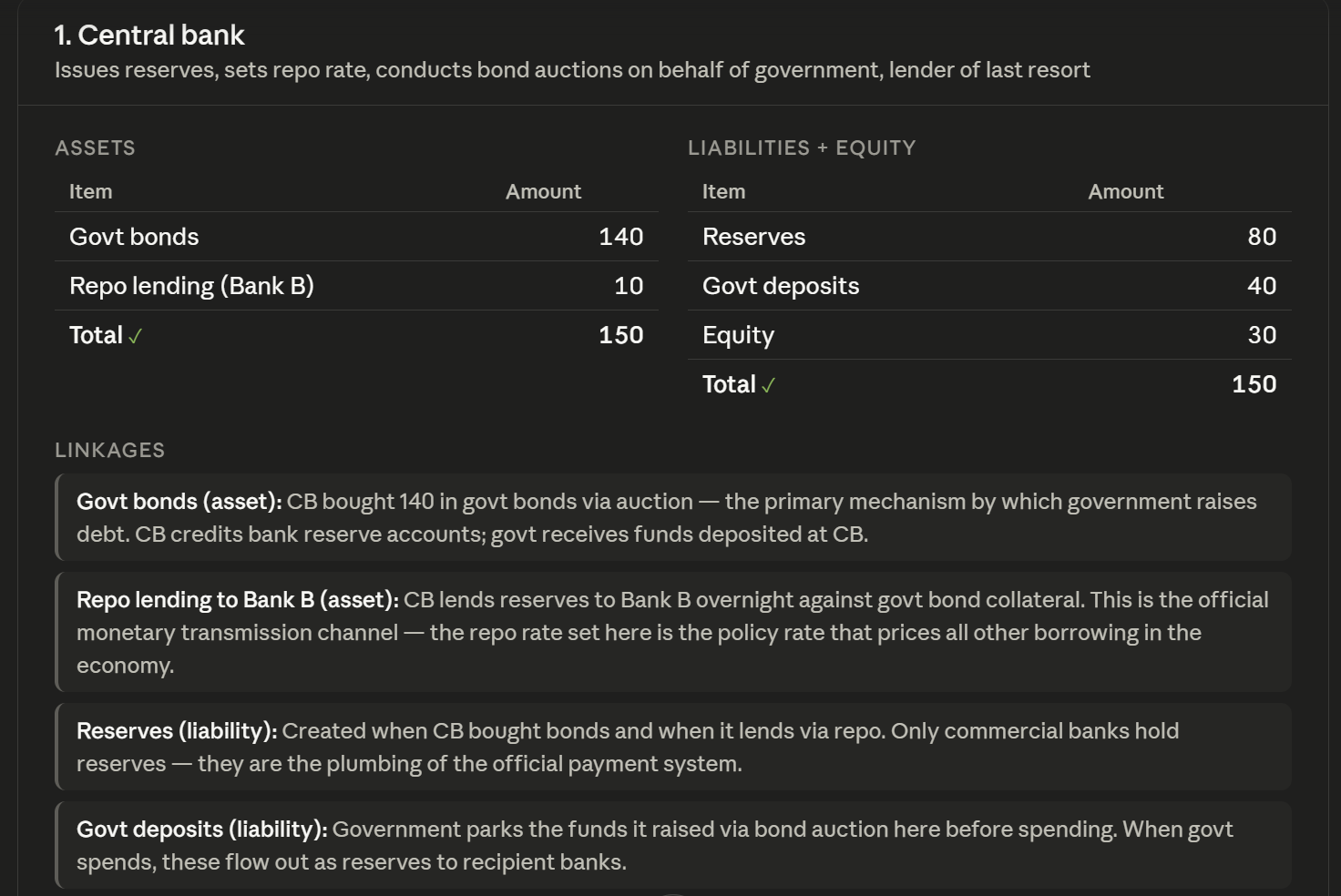
Illustrative opening balance sheet: Central bank.
Bank A
A deposit-taking bank that lends to firms and the NBFC, lends reserves to Bank B, participates in repo and reverse repo, and is therefore exposed to both the formal banking system and shadow banking.
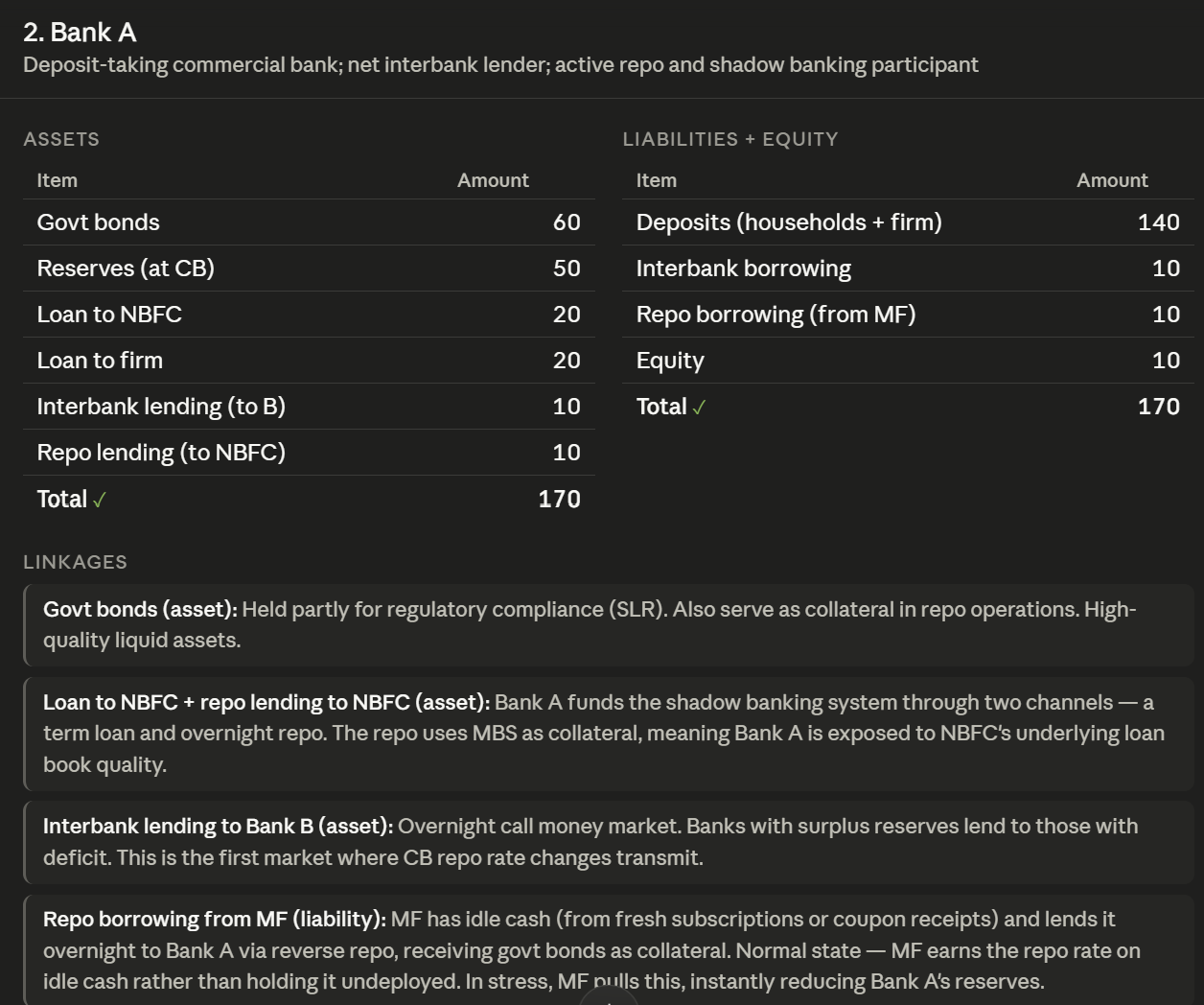
Illustrative opening balance sheet: Bank A.
Bank B
A reserve-deficit bank that borrows from Bank A and the central bank and holds securitized NBFC-originated loans through mortgage-backed securities.
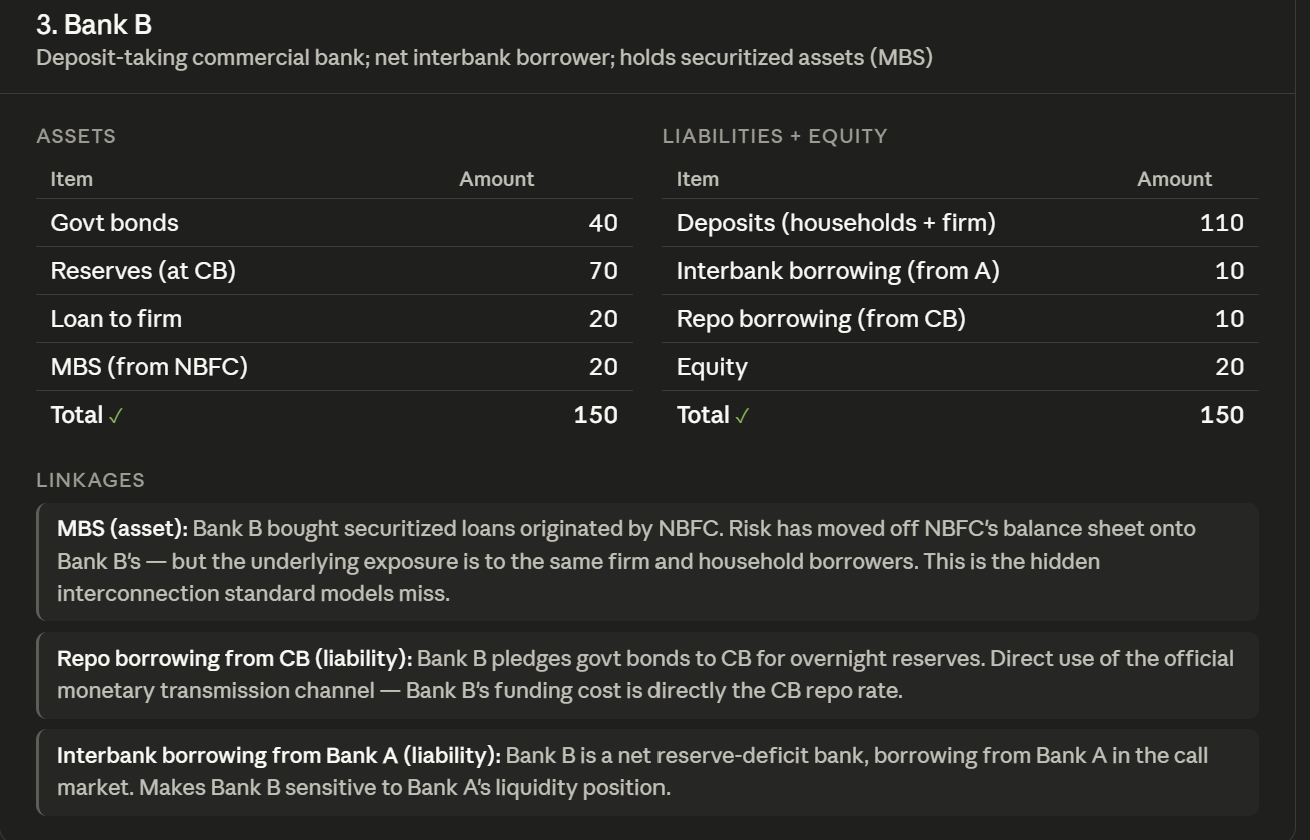
Illustrative opening balance sheet: Bank B.
NBFC
Borrows short and lends long, has no direct central-bank access or deposit insurance, depends on commercial paper, bank loans and repo, and carries a classic maturity mismatch.
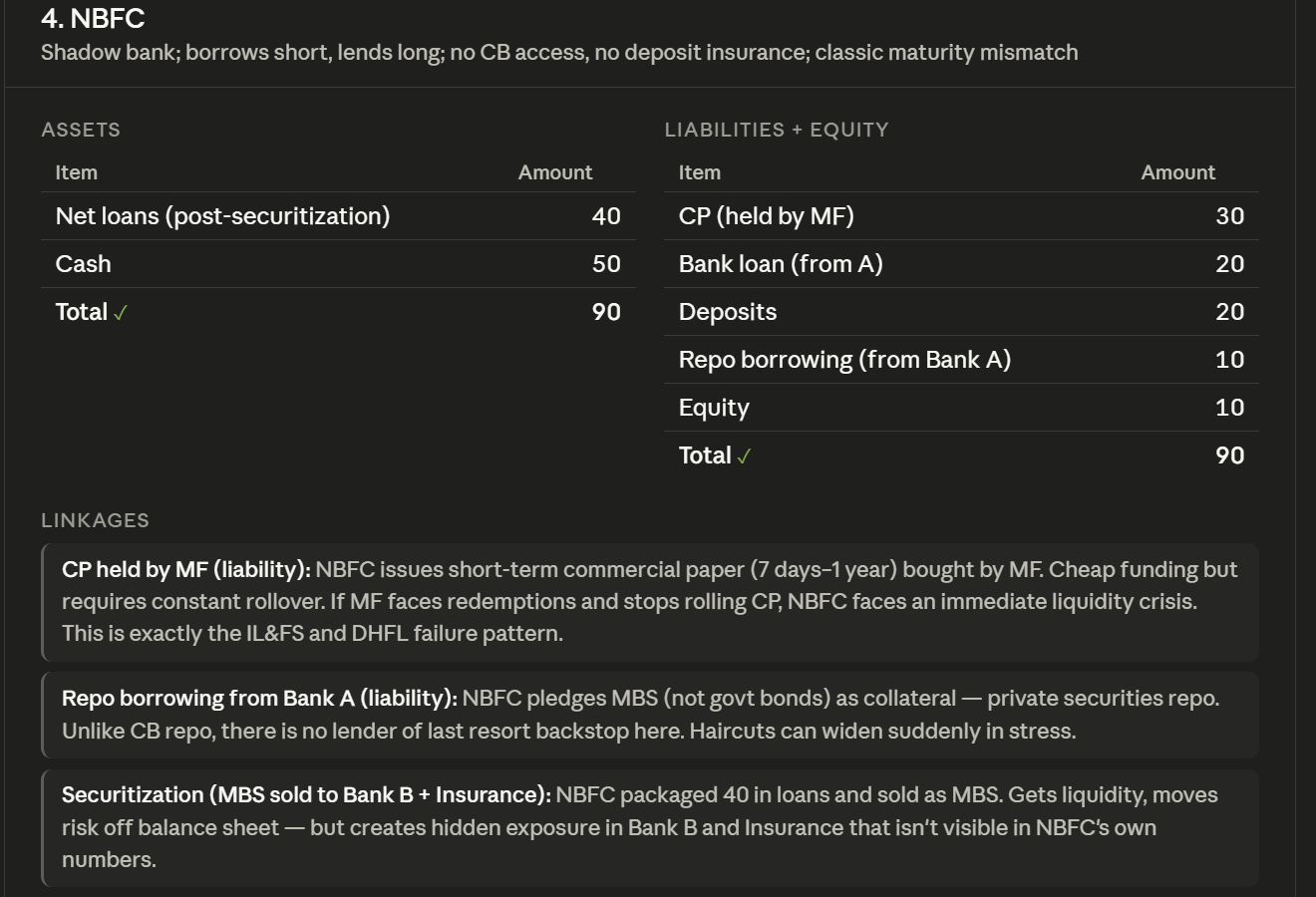
Illustrative opening balance sheet: NBFC.
Mutual fund
Pools household savings, marks assets to market daily and holds government bonds, NBFC commercial paper, corporate bonds, equities and reverse repo. It is the fastest stress transmitter in the system.
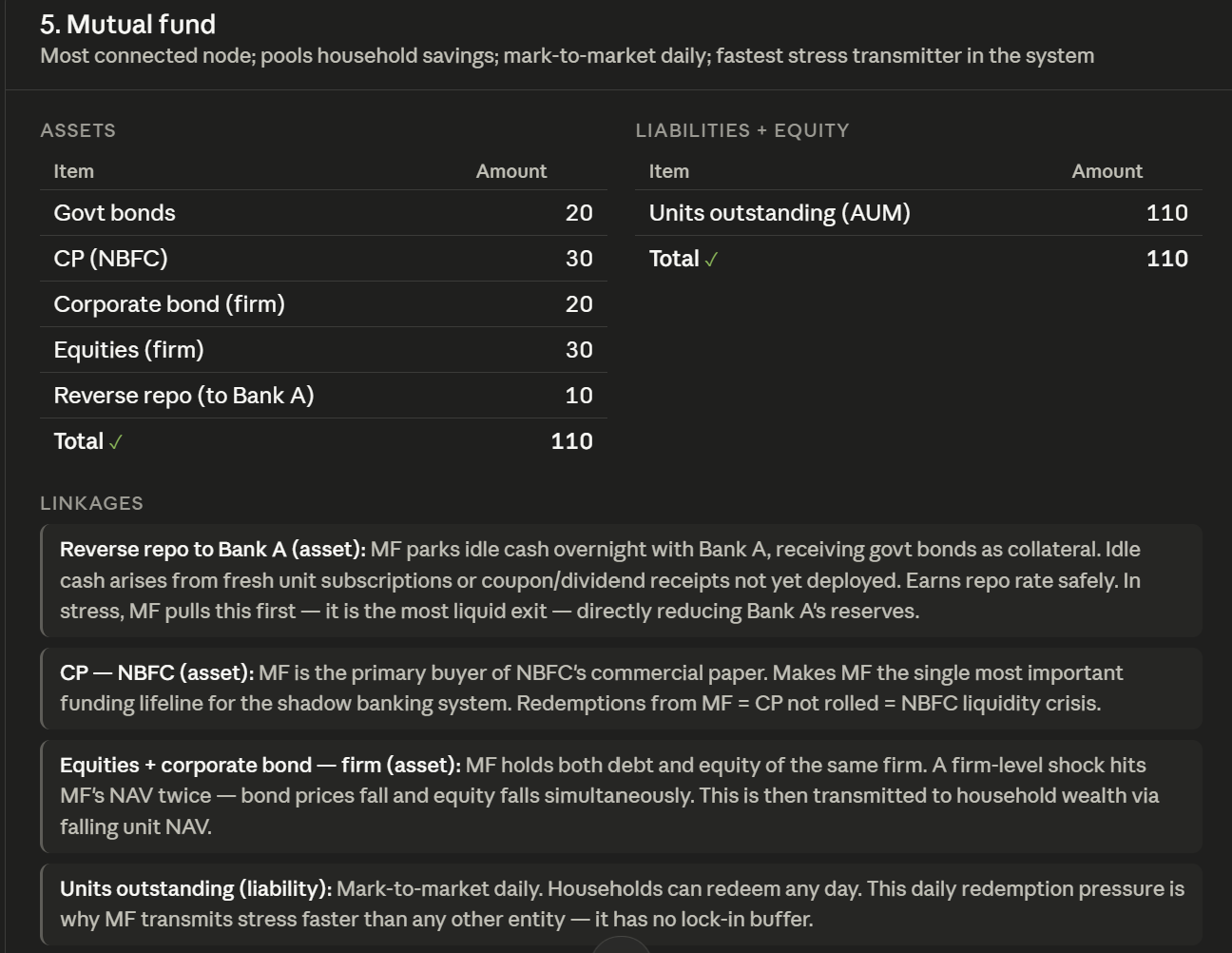
Illustrative opening balance sheet: Mutual fund.
Insurance company
A long-duration investor with sticky liabilities. It holds government bonds and NBFC-linked securitized assets, making it relatively stabilizing in bond-market stress but exposed to hidden credit risk.
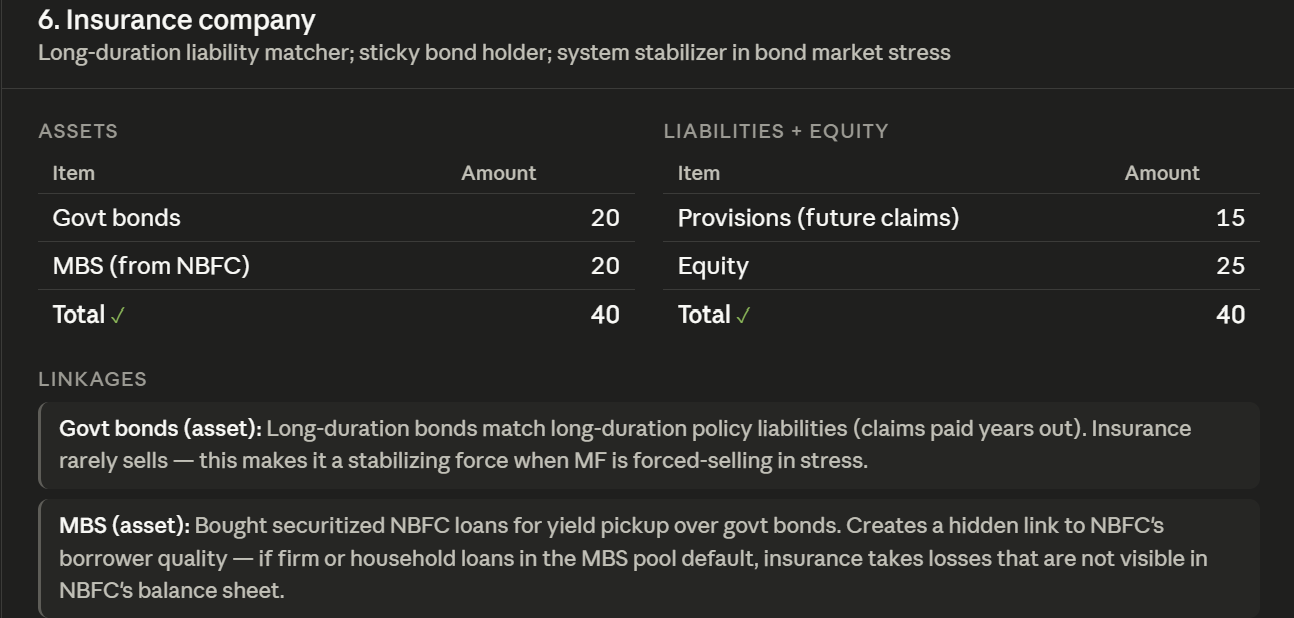
Illustrative opening balance sheet: Insurance company.
Firm
The real-economy borrower. It simultaneously relies on the NBFC, both banks, the bond market and equity investors, so a firm-level default can transmit across several balance sheets at once.
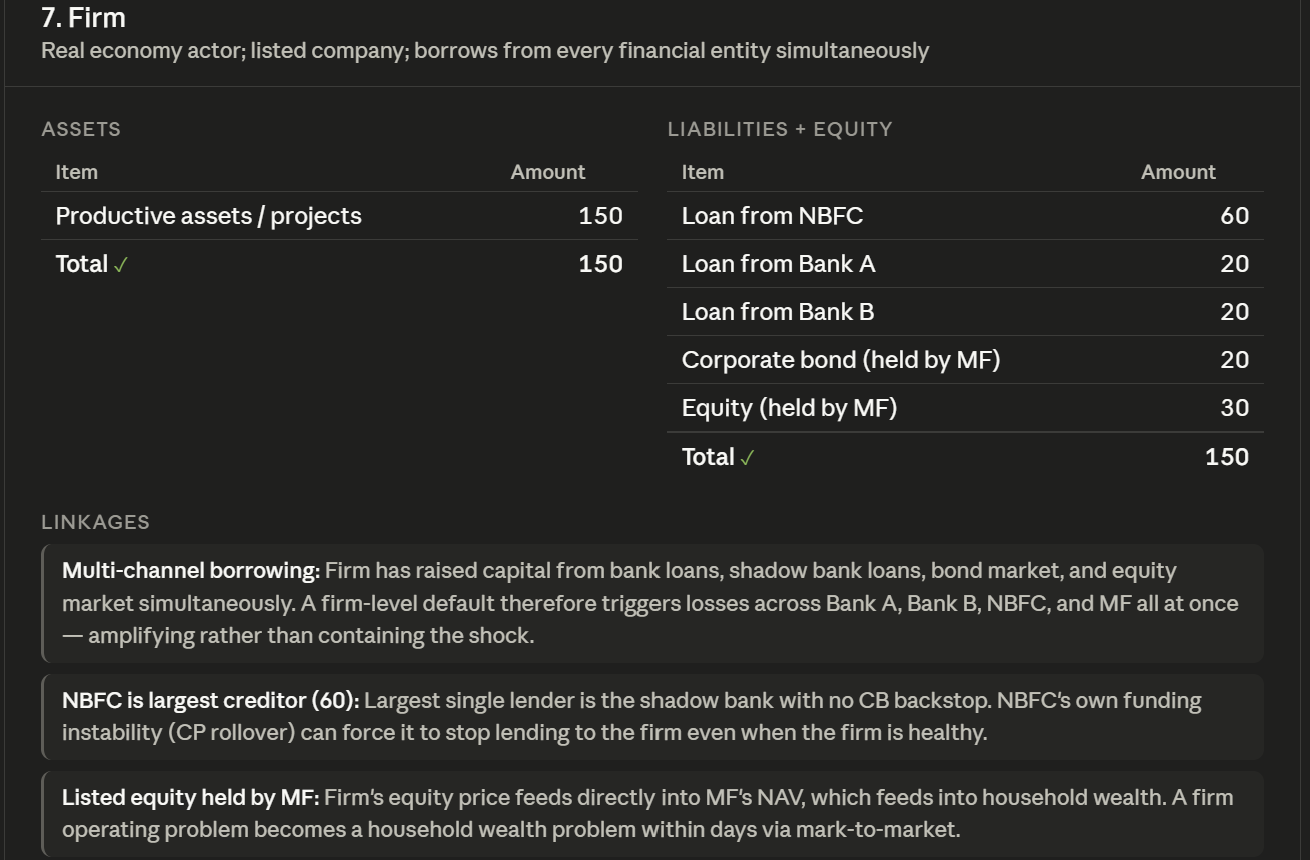
Illustrative opening balance sheet: Firm.
Household
The ultimate source of deposits and mutual-fund savings, and also a borrower from the NBFC. Household wealth is directly exposed to daily market prices through mutual-fund NAV.
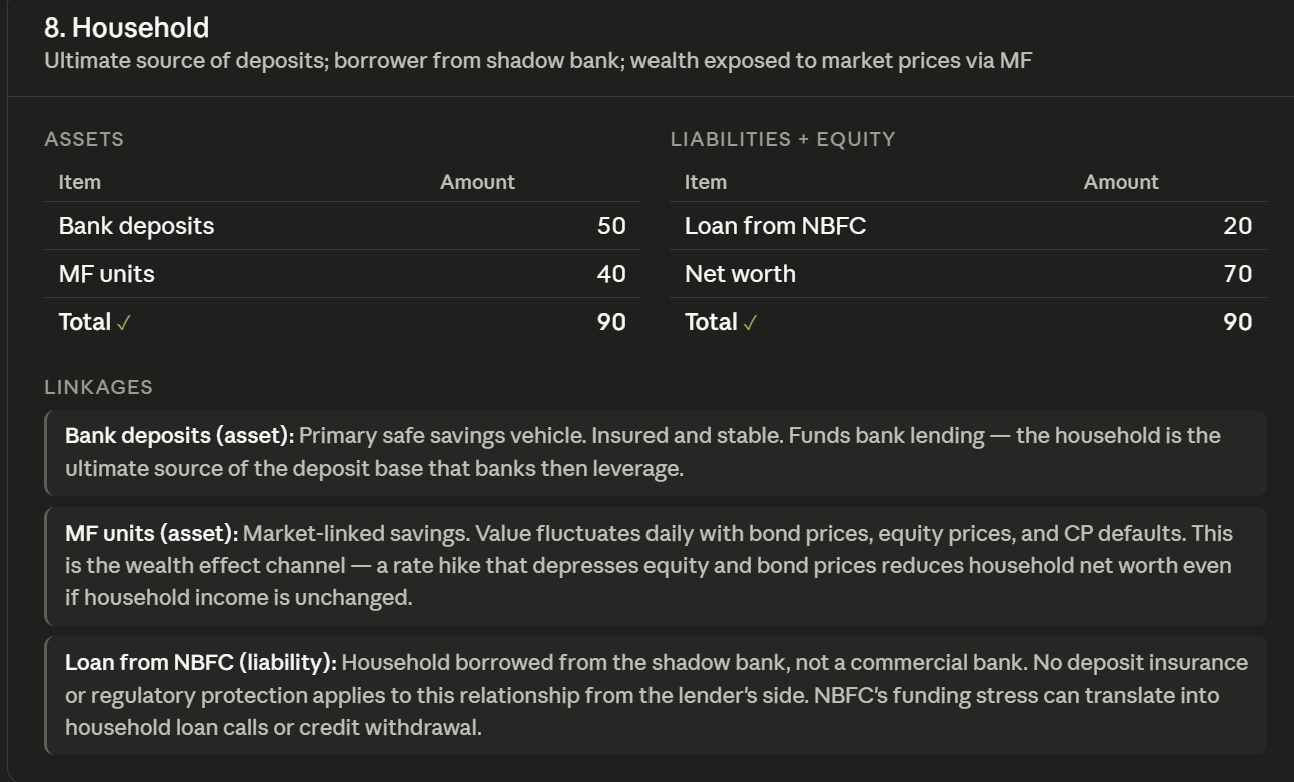
Illustrative opening balance sheet: Household.
Two design choices create realistic contagion
First, the mutual fund has no equity buffer. Any loss in its assets immediately reduces NAV and therefore passes directly to households. Because units are marked to market daily, redemption pressure can emerge rapidly.
Second, the NBFC depends on short-term funding. It borrows through commercial paper, bank loans and repo while lending into longer-duration assets. If funding is not rolled over, the NBFC faces an immediate liquidity problem even before all of its underlying loans have defaulted.
The network is not a chain
The important links are: mutual fund to NBFC through commercial paper; mutual fund to Bank A through reverse repo; banks to the NBFC through loans and repo; banks and the NBFC to the firm through credit; and households to the mutual fund through investments. Because several institutions are connected in more than one direction, a shock can return to its starting point after travelling through the network.

2. How the simulation works
A shock is introduced by directly changing the value of an asset or a source of funding. A rate hike reduces bond prices. A commercial-paper freeze cuts NBFC funding from mutual funds. A credit downgrade reduces the value of loans and bonds.
After the initial shock, equity is recomputed as assets minus liabilities. That is Round 0. The model then allows institutions to respond to the constraints they face:
- Mutual funds meet redemptions by selling assets or withdrawing funding.
- Banks under stress tighten lending and liquidity provision.
- The NBFC cuts lending when funding disappears.
- Firms deteriorate when the supply of credit contracts.
The system is then recomputed, the responses are applied again, and the process continues until the network stabilizes or one or more entities become insolvent.
- Apply the shock.
- Recompute all balance sheets.
- Apply behavioural responses forced by liquidity, capital and funding constraints.
- Recompute again and repeat until stability or insolvency.
For every simulation, I track equity changes, insolvencies, the number of rounds required for the system to settle, and the amplification of losses relative to the initial impact.
3. Shock One: a 50-basis-point rate hike
The first experiment is a conventional valuation shock. Higher yields reduce the price of fixed-income assets held across the system.
Entity | Starting equity | Round 0 equity | Loss |
|---|---|---|---|
Bank A | 10.00 | 8.55 | -1.45 |
Bank B | 20.00 | 18.90 | -1.10 |
NBFC | 10.00 | 8.70 | -1.30 |
Insurance | 25.00 | 24.50 | -0.50 |
Household | 70.00 | 69.38 | -0.62 |
Mutual fund | 0.00 | 0.00 | 0.00 |
Firm | 0.00 | 0.00 | 0.00 |
No entity breaches a constraint. No funding is withdrawn, no balance sheet is forcibly contracted, and the simulation stops after the first round. Total amplification is therefore 0%.
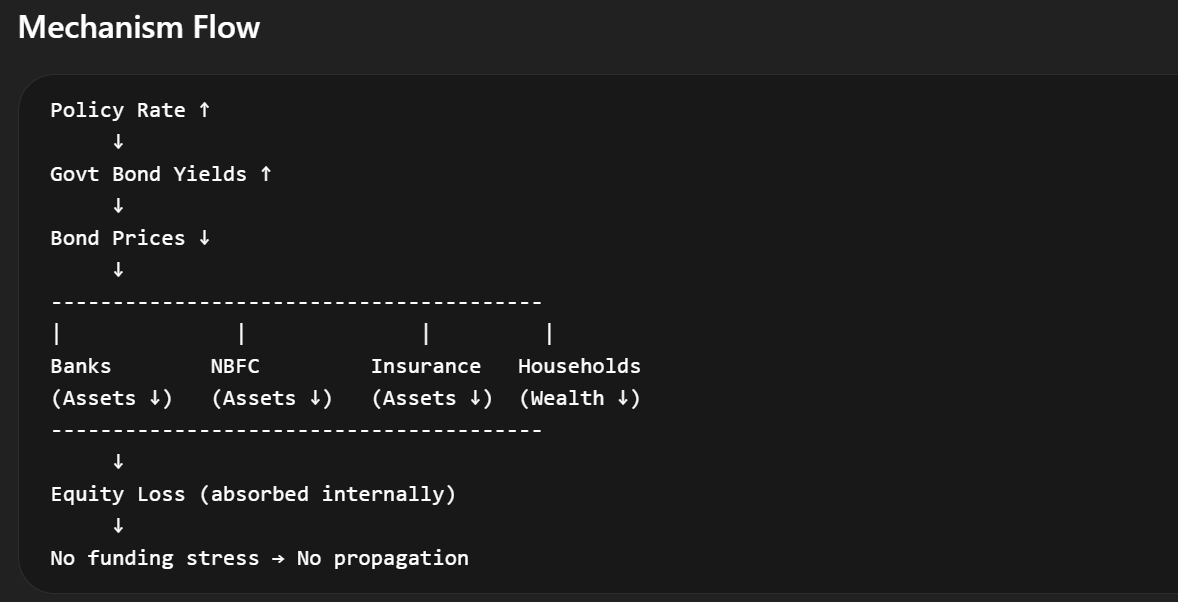
Rate-hike mechanism: asset prices fall, but equity buffers absorb the loss and prevent propagation.
A 50 bps rate hike reduces Bank A equity by 1.45, yet it does not trigger a systemic response. |
|---|
The important point is not that rate hikes are harmless. It is that this particular shock remains a pure valuation shock inside this model. Existing capital buffers are sufficient, so the first-round losses do not force any institution to deleverage or withdraw funding.
4. Shock Two: a 50% freeze in commercial-paper funding
The second experiment strikes the system at its liquidity constraint. Mutual funds stop rolling over half of the commercial paper used by the NBFC. The initial event is concentrated, but the response is immediate and systemic.
Round 0: the localized shock
Entity | Starting equity | Round 0 equity | Initial loss |
|---|---|---|---|
NBFC | 10.00 | -7.50 | -17.50 |
Mutual fund | 0.00 | -15.00 | -15.00 |
Bank A | 10.00 | 7.50 | -2.50 |
Bank B | 20.00 | 18.50 | -1.50 |
Insurance | 25.00 | 23.50 | -1.50 |
Household | 70.00 | 69.00 | -1.00 |
Firm | 0.00 | 0.00 | 0.00 |
The NBFC is already effectively wiped out, while the mutual fund is deeply negative. But Round 0 is only the beginning.
Round 1: the feedback loop activates
Households redeem mutual-fund units. The fund must meet those redemptions, so it liquidates assets and withdraws money placed with Bank A through reverse repo. The mutual fund’s equity falls further from -15.00 to -16.89.
Bank A then takes a secondary hit. Its equity declines from 7.50 to 3.94. Its total loss becomes 6.06 compared with an initial loss of 2.50—an increase of 142% caused by feedback rather than by the original funding freeze alone.
The NBFC remains insolvent, moving from -7.50 to -7.97. It has no commercial-paper funding and bank funding tightens. The contraction now reaches the real economy: the firm moves from 0.00 to -0.52 as NBFC lending is cut. Household equity falls from 69.00 to 67.11, making the total household loss 2.89—almost three times the initial loss of 1.00.
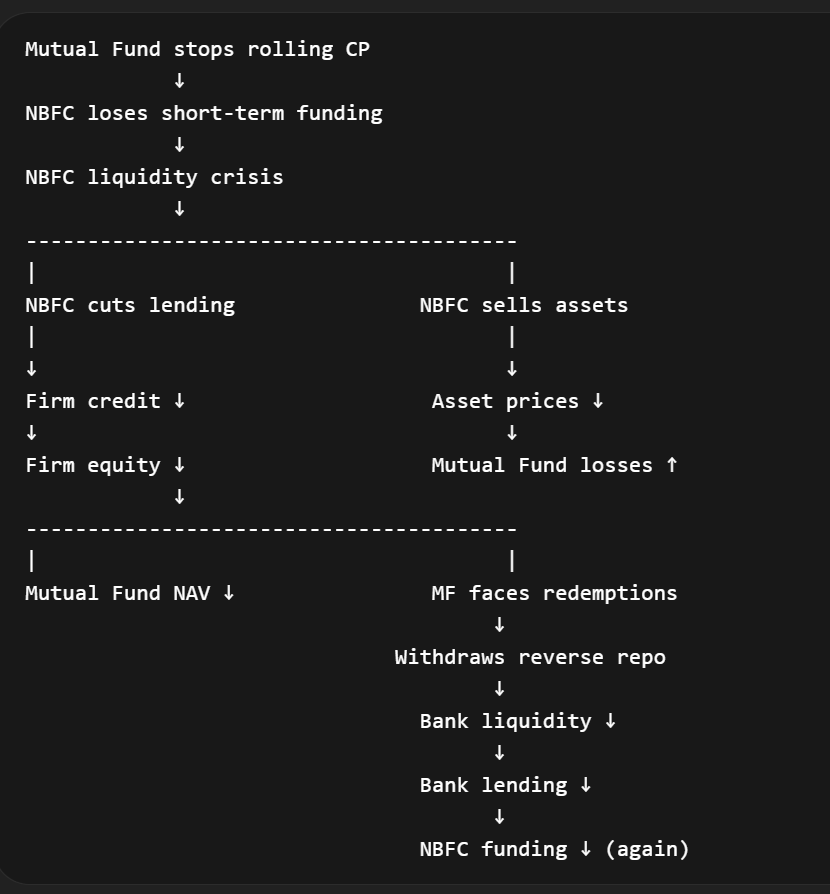
Commercial-paper freeze: funding loss triggers a liquidity crisis, asset sales, redemptions and a second tightening of NBFC funding.
Entity | Round 0 | Final equity | Total outcome |
|---|---|---|---|
Bank A | 7.50 | 3.94 | -6.06 |
NBFC | -7.50 | -7.97 | Insolvent |
Mutual fund | -15.00 | -16.89 | Insolvent |
Firm | 0.00 | -0.52 | -0.52 |
Household | 69.00 | 67.11 | -2.89 |
Transmission path: Mutual Fund → NBFC → Bank A → Firm → Household |
|---|
The commercial-paper freeze operates through a liquidity-withdrawal channel. The NBFC loses a critical source of short-term funding and collapses. Mutual-fund losses trigger redemptions. To meet them, the fund withdraws liquidity from banks. Banks then reduce lending, worsening conditions for the NBFC and the firm. The original shock becomes a self-reinforcing loop.
5. Shock Three: a two-notch credit-rating downgrade
The third experiment begins more quietly. The downgrade reduces the value of loans and corporate bonds, but it does not trigger the immediate funding run seen in the commercial-paper freeze.
Entity | Starting equity | Round 0 equity | Initial loss |
|---|---|---|---|
Bank A | 10.00 | 8.00 | -2.00 |
Bank B | 20.00 | 18.00 | -2.00 |
NBFC | 10.00 | 4.00 | -6.00 |
Household | 70.00 | 64.76 | -5.24 |
Other entities are largely unaffected in the first round. Yet Bank A keeps deteriorating after the initial shock:
Iteration | Bank A equity |
|---|---|
Round 0 | 8.00 |
Round 1 | 5.89 |
Round 2 | 4.02 |
Round 3 | 2.22 |
Round 4 | 0.36 |
Round 5 | -1.54 |
Round 6 | -3.51 |
Round 7 | -5.57 (insolvent) |
This deterioration is not driven by a sudden liquidity withdrawal. It is driven by a capital-erosion loop: loan-book deterioration leads to incremental provisioning; the bank tightens its balance sheet; credit supply contracts; firm conditions worsen; and asset quality deteriorates again.
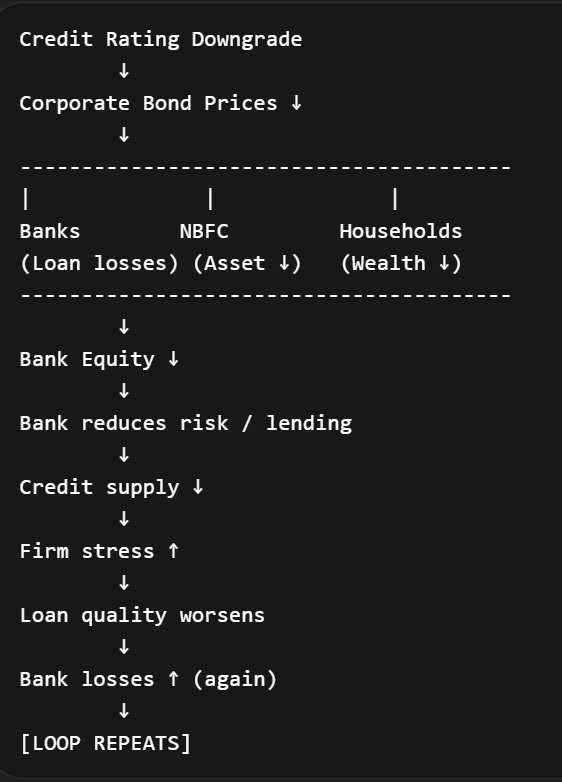
Credit downgrade: a slow loop of capital loss, lending contraction, firm stress and further loan deterioration.
Bank A’s initial loss of 2.00 becomes a final loss of 15.57—an amplification of 678%—and insolvency arrives only after seven rounds. |
|---|
The mutual fund remains stable, the NBFC stabilizes after its initial hit, and there is no major liquidity withdrawal. Contagion is therefore localized. But the absence of an immediate cascade should not be mistaken for safety: the bank moves from +8.00 after Round 0 to -5.57 after repeated balance-sheet adjustments.
6. One system, three completely different crises
Shock | Amplification | Insolvency | Speed | Dominant mechanism |
|---|---|---|---|---|
Rate hike | 0% | None | Immediate stabilization | Valuation |
50% CP freeze | 140–180% | NBFC, mutual fund | 1 round | Liquidity cascade |
Credit downgrade | Up to 678% | Bank A | Slow: 7 rounds | Capital erosion |
These outcomes reveal why the label attached to a shock is less informative than the constraint it hits first.
- When equity buffers absorb the loss, the shock stops.
- When liquidity is withdrawn, the network cascades.
- When capital erodes gradually, failure can be delayed but much more strongly amplified.
7. The deeper insight: resilience is constraint-specific
A financial system is not simply “strong” or “fragile.” It can be resilient to one class of shock and highly vulnerable to another. The same institutions, with the same opening balance sheets, survive a rate shock, collapse almost immediately under a funding freeze, and experience a slow bank failure under a credit downgrade.
That difference comes from institutional behaviour. Equity losses matter when they breach capital limits. Funding losses matter when liabilities must be rolled over. Mark-to-market losses matter when investors can redeem immediately. Credit losses matter when provisioning and lending contraction feed back into borrower quality.
Systemic risk is created not only by common exposures, but by the actions institutions are forced to take after those exposures are hit. |
|---|
This is why a balance-sheet network view is useful. It does not stop at asking who owns the impaired asset. It asks who must sell, who must withdraw funding, who must cut credit, and where that response returns as a second-round loss.
Conclusion
The three experiments tell a common story. First-round losses are only the visible surface of financial stress. The eventual outcome is determined by feedback: whether capital absorbs the hit, liquidity vanishes, or balance-sheet tightening slowly damages the real economy and returns as fresh credit losses.
In this model, the 50 bps rate hike is contained. The 50% commercial-paper freeze creates an immediate liquidity cascade that wipes out the NBFC and mutual fund. The credit downgrade appears manageable at first, yet repeated capital erosion drives Bank A into insolvency after seven rounds.
The practical lesson is therefore not merely to measure the size of the initial shock. It is to identify the first binding constraint—and then trace every forced response through the network until the system either stabilizes or fails.
Method note
This is an illustrative balance-sheet network designed to isolate transmission mechanisms. The values are model units rather than estimates of the full Indian financial system. The model emphasizes accounting links, funding dependence, mark-to-market transmission and iterative behavioural responses; it does not claim to capture every regulatory, institutional or market feature.